We were definitely ready to get out of the city. Phnom Penh was a busy, loud, and dirty place. Walking down the street was never an easy process, as sidewalks were usually crammed full of motorbikes parked in front of shops, forcing you to walk on the road and dodge motorbikes flying by in both directions. A couple days ago, we were crossing a major eight-lane boulevard at one of the only traffic lights we had seen. Weaving between stopped cars that had run the red light, we were within four feet from the far curb, when two motorbikes came flying out of nowhere IN THE WRONG DIRECTION! What the hell?! Turns out that the easier way to turn left at an intersection rather than waiting for the left turn signal is to make your way across oncoming traffic and drive along the curb until your corner comes up. And when driving down the road, it seems perfectly ok to simply cross into oncoming traffic's lane if those in front of you are driving too slow - even if there is traffic coming. Intersections are a high speed game of "thread the needle", even across multiple lanes of traffic. Driving at home is going to seem like the safest thing ever after this!
As we boarded the bus this morning bound for Kep in southwestern Cambodia, we recognized a bunch of people taking the same bus who we had previously met while in Phnom Penh, on the boat to Battambang, or even as far away as Siem Reap. It's funny how backpackers tend to travel the same paths - and this works out really well when you meet people going in the opposite direction, as you can trade info and make recommendations about where the others are headed.
Rice fields lined with palm trees stretched all the way to Kampot, where some low mountains started to appear and the turquoise Gulf of Thailand appeared on our right. Kep is a tiny little seaside town that was deserted during the Khmer Rouge raids in the 1970s and the famine that followed, and life has just recently started to resume. Oceanside thatched huts had dozens of hammocks for people to lounge in while dining on Kep's famous fresh caught crab. The town seemed pretty deserted though, so we opted to carry on toward the Vietnam border. Somehow! A tuk-tuk driver agreed to take us there for a fair price, so we piled in and were off. The first half hour was eastbound on a decent paved road, but then we turned south onto a dirt road that I had thankfully read was a shortcut - otherwise, we might have been worried! How much of a time saver, we weren't sure, as the road was riddled with potholes so deep that we had to get out and walk around them once! We drove by villagers' houses and farmsteads, where kids waved hello and cattle grazed at the roadside. After about an hour, the houses and grazing fields were replaced with long thatched sheds and sprawling grids of bare flooded fields. We thought they were more rice paddies, but our driver pulled over to show us that they were actually for harvesting sea salt. Low berms seperate the square fields, which are tamped to densify the soil and then flooded to allow about 6 inches of ocean water in. The pond is left to evaporate, which leaves behind a carpet of sparkling salt crystals. The salt is raked into mounds and bagged for export to Vietnam, just a few kilometers away.


Apparently, the last few kilometers before the border are pretty rough, so our driver had called a couple of his friends with motorbikes to meet us at the end of the "good" part. Each of the drivers balanced our packs between their legs while we climbed on behind them. It was only a few kilometers to the border, where we bailed off and made our way through the customs office on the Cambodian side. Just on the other side of the official flimsy steel gate was the flower-lined welcome sign and towering arch of the Vietnamese border. Since our drivers live right near the border, they are permitted to ferry people back and forth as they please - which is good, because unless you have your own bike or car, this is the only way of crossing the border here! Everything went smoothly, and we were soon zipping down the highway to the Vietnamese town of Ha Tien. Country #12 on our trip list!

Since this border crossing is very new, it is not mentioned in any of the guidebooks, hence the "winging it" theme to today's adventure! We were therefore assuming that the long-running fast ferries from the town of Rach Gia, 100km farther south, were the only way to get to Phu Quoc island. One of the motorbike drivers mentioned a new fast ferry service from Ha Tien, so we had him take us to their ticket office to check it out. The Lonely Planet had warned that the only boats from here to the island are slow fishing boats, and that you should not take them if you value your life! But this new fast ferry looked great in the photos in the office - new and safe - but we had to make the salesgirl promise us that the boat in the picture was the actual boat - otherwise, we weren't going to risk it. So trusting her word, we found a hotel room and hung out for the rest of the day, awaiting the 8am departure tomorrow morning.
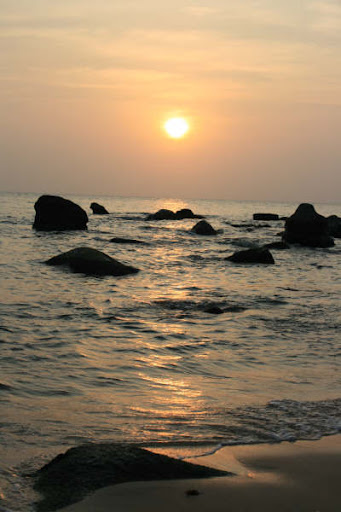
For arriving in Ha Tien knowing nothing about the town since it's not covered in our guidebook, we were very impressed! A big market bursting with fresh produce lined the street near our hotel, colourful fishing boats lined the waterfront, and countless little shops and cafes stretched the length of the main drag. A wide promenade borders the ocean, where a massive flower sale was underway as people prepare for the upcoming Lunar New Year. The people were all friendly, and not a single person hassled us. We only spotted two other foreigners, and no english was visible on signs around town. This place has not been on the tourist trail, but we suspect that it will be soon with the new border crossing into Cambodia and the new easy access to Phu Quoc island, which is an upcoming hotspot for beaches and diving. We wandered the town, enjoying the laid back vibe and the pretty sunset. Tomorrow, the beach!





 Posts

