Monday, January 12, 2009

More caves and creepy crawlies (Jan. 7/09 - Gunung Mulu National Park, Borneo, Malaysia)

Instead of taking a boat up the river to the other two caves as everyone else was doing, Ken and I opted to walk the 4km trail between camp and the Cave of the Winds. The trail followed the river through the rainforest for an hour before a long set of steps ascended into the trees. 425 stairs later, we came to the entrance of Moonmilk Cave, which is named for the strange white gooey layer of calcite crystals that has formed on the walls. The passage was quite narrow, and we had to duck and squeeze through a few spots between pillars and stalactites. When we emerged at the other side, it was a steep descent back to river level on extremely slippery algae-covered steps that were built at just enough of an angle to prevent you from getting a good foothold. Ken bailed a couple times and I had a few close calls too, but eventually we made it to the entrance to the Cave of the Winds, where a dozen others were waiting for the tour to start. Normally, a cool breeze blows through this cave from another entrance deeper inside, but today it was so hot out that there wasn't much of a breeze at all. The limestone formations inside were beautiful - especially an area called the King's Chamber, where dozens of tall, thin pillars appeared to hold up the roof. We retraced our steps to the entrance and followed the trail along the river to the mouth of the fourth of the main show caves - Clearwater Cave. This cave system was originally mapped by the Royal Geographical Society (Britain) in 1977, and multiple expeditions have occured since then, the most recent one being in 2004, which discovered more and more levels, branches, and passageways in the cave system that are so convoluted on the map that it's hard to believe it was all explored by hand. The current estimate is that the Clearwater Cave system contains about 140km of passages, which ranks it in the top ten longest caves in the world. Although it is difficult to estimate, it is thought that in terms of volume, this is likely the largest cave system in the world. Odds are also very good that many more passages will be discovered with each subsequent expedition. Visitors to the park can go on 'adventure caving' trips, where you are taken deep into the cave to climb/scramble/jump/squeeze/swim your way through the maze of passages with only a helmet and a light. If we had more time here, that would definitely have made it onto our itinerary!

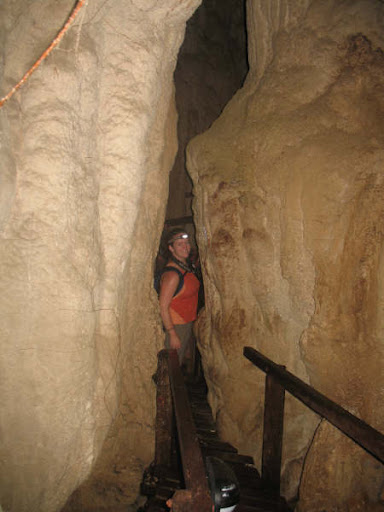
The entrance to Clearwater Cave is at the top of 200 steps that take you up the cliff face above the churning pool of fresh water that is forced up from a submerged cave to become a river. Framing the entrance are a collection of strange single-leafed plants that all grow facing towards the sun. This cave is unlike the others we've seen because a fast-flowing river races through the cave, still working its erosive powers on the floor and walls of the cave, much like it has for centuries. The walls are a storeyboard of the river's history, as ridges and scalloped edges indicate how much water was flowing and in which direction it was moving. A large skylight allowed sunlight to stream down into the cave, and the guide pointed out a small opening that dropped down out of sight like a manhole beside the trail. Apparently, this route links up with the Cave of the Winds in a wild 8 hour trip through the belly of the mountain in the pitch black. As exciting as that sounds, we opted to take the longboat ride back to camp for some lunch and a shower instead :)

We spent the lazy afternoon reading the rest of the displays in the Discovery Center, napping, and wandering slowly down the various rainforest trails around the camp to see what sorts of creatures we could find on our own when we really looked. Later in the evening, we went with a guide for a night walk, where we walked slowly with flashlights to see what was crawling around in the dark. In addition to all the strange/large/disgusting beetles we found, there was also a big black tarantula, two cute little bright green tree frogs, lots of fireflies, moths, giant ants about an inch long, pitcher plants, a huge white "moon rat", and a big lizard that darted across the trail running on its hind legs. The rainforest hummed with the sounds of insects and frogs. Some we heard sounded like ambulance sirens, the Jaws theme song, a swinging rusty gate, a digitized water droplet sound, and a car alarm! When we were about a kilometer from camp, we heard the telltale thunder rumble overhead, which meant only one thing - get out your raincoat, and get it FAST! The downpour started within seconds, and the dense rainforest canopy was no longer any help at keeping the rain off the trail. Within a minute we were absolutely drenched (all but the cameras, thankfully), and we surely raced past lots of great jungle stuff on the mad dash back to camp, but we had already seen a lot! A bunch of people were still on the patio eating dinner when we walked up in the dark, looking as though we had fallen in the river. Apparently we were a pretty funny sight! So now our room is a haphazard mess of newly wet and previously washed clothes that will hopefully dry by tomorrow morning (they won't!) or else they will develop a smell when packed in our bags that can only be described as toxic. We will certainly not take our clothes dryer at home for granted after this trip!

Another day out of National Geographic (Jan. 6/09 - Gunung Mulu National Park, Borneo, Malaysia)

Our little Dash-8 plane was skimming the rainforest treetops and touching down in Gunung Mulu National Park even before 10am this morning. Our bags were unloaded amongst boxes of food headed for the camp, as everything here has to be flown in from Miri or transported by boat up the river. At the park headquarters, we got the lowdown on which hikes, walks, and other activities would fit into our three day saty. We were pointed in the direction of our room, nestled amongst the rainforest in a building that also has a cafe, food and gift shop, and a museum-like discovery center that explains everything you wanted to know about the park's geology, vegetation, etc.

The Lonely Planet describes Mulu as "the single most impressive destination in all of Borneo." That's a tall order to live up to, but we're pretty sure it's deserving. The park's highlight is its caves - dissolved and eroded out of limestone, they comprise the largest, longest, and most impressive caves on the planet. The peaks above all the caves can be climbed as another highlight, and one area called The Pinnacles comprises a jumble of razor sharp white limestone spears that jut out some 50m above the rainforest. The forst itself is definitely another highlight, as the park is entirely untouched and contains some of the most ecologically rich plant and animal life on earth. Oh yeah, and there are also postcard perfect waterfalls to hike to, crystal clear streams to swim in, and even a treetop path that gets you up into the rainforest canopy. Sounds like paradise to me - and here we are!


First up is Lang's Cave. It's actually the smallest of Mulu's four "show caves" (awesome and easily accessible, that is), but it contains some fascinating limestone formations that have formed over thousands of years of water droplets slowly dripping from the ceiling, running down the walls, and flowing along the floor. Lights have been placed in the cave to highlight the natural beauty of the formations, and some of them were so artistically bizarre that it was hard to even imagine how they formed. We walked for an hour through the rainforest to get to the caves, but along the way we were accompanied by all kinds of colourful butterflies, huge beetles, camoflauged lizards, oversized vegetation, and even a giant stick bug! We had seen stick bugs before, but this one must've been almost a foot long!


After we exited Lang's Cave, we entered Deer Cave, whose mouth is just a short walk away. Deer Cave has the largest cave passage int he world - 174m in height and over 2km in length. Approaching it, we were speechless - the cave's mouth was so enormous that you could barely make out the top! 174m is tall enough to build a 50 storey building inside. Yeah - holy crap! It felt as spacious as walking into BC Place... just awesome. Niah Caves yesterday were amazing, but they were tiny compared to this! Water showerd down in veil-like streams from multiple fissures in the ceiling, which made for a beautiful scene as we walked further inside and looked out toward the daylight streaming in. A river flows through the cave, logically, as that is what formed it in the first place, though it is just a trickle now. The trail carried on into the dark depths of the cave, where the echoing sound of the river was nearly deafening. Daylight became visible at the far end, where the river flows in from a patch of pristine jungle called The Garden of Eden before returning to another cave a little farther up. Birds and bats could be seen flitting around inside the cave, but the ceilings were so high that you really couldn't see them very well. Yet.


A couple years ago, a magnificent series of documentaries called Planet Earth were produced, each of which featured unique and remarkable natural wonders around the world. We have only seen a few of them, but one that was particularly memorable was about a bizarre mass exodus of millions of bats from a remote cave in the jungles of Borneo. Well guess what - it was Deer Cave. We left the cave behind and took a seat at a viewing area in front of the cave entrance. Every day, the 2.5 to 3 million bats that are estimated to inhabit Deer Cave fly out en masse to feed on jungle insects at dusk before returning to the cave at dawn. As if on cue, at exactly 6:00pm as we gazed at the cave intently, a black swarm of nearly indistinguishable black dots emerged from the cave in a long stream, warping and bending into spirals and arcs like a giant black snake in the sky. It was an amazing sight - literally millions of bats performing precise acrobatics with the intent of confusing predatorial birds as they made a run for the forest. At first, the streams came in "short" lengths, as if a gate was closing at the cave mouth to hold the rest back - but eventually the streams became longer, and finally one giant cloud of bats emerged, taking several minutes to pass overhead. More shorter streams followed, sometimes several at once, and then isolated blobs of bats began to appear higher in the sky and coming from behind the hills in front of us - these would be bats emerging from other caves nearby. One stream broke into two lines that spun into a near perfect double helix, and another turned in a cylindrical tube over and over again in place, possibly unable to decide who was in front! We counted at least 54 individual streams emerging from Deer Cave alone, each comprising thousands of bats. They were still going strong after 30 minutes, and we eventually left them to their aerial circus so we could get back to camp before dark. Between the sheer natural beauty and imensity of the caves and the incredible show displayed by the millions of bats, today felt like one of those days where you have found a special corner of the world that is almost too precious to share. Almost.

Bird's nest soup, anyone? (Jan. 5/09 - Miri, Borneo, Malaysia)

The rains quit just as we were heading out for the day to explore Niah Caves, but we took our rain gear anyway - more for protection from falling bat crap than anything else! A well maintained boardwalk passes through about 3km of beautiful rainforest before reaching the caves, and the mist hanging in the trees made for a beautiful walk. Twisting vines and gigantic leaves hung over the trail, and strange trees grew to several metres in diameter with huge butress-like roots growing out of their bases to support them in the wet soil. Exotic birds and bug chirped and buzzed their bizarre calls as we walked, and bright red millipedes scurried across the walkway every now and then. Eventually, we could see towering white limestone cliffs through the trees above us, and the trail climbed up until the gaping mouth of the Great Cave was before us. The cave was monsterous - some 60m high and 250m wide, with a floor area of over 10 hectares! One side was fenced off to protect the area of the archaeological dig that has been underway since the 1950's, but the graves of dozens of bodies were obvious along the north wall of the cave. The floor was compact but slippery, the product of thousands of bats and birds that hang out on the ceiling and fly in and out of the cave each day. Pits were obvious where locals still collect the guano and sell it as plant fertilizer. As you could imagine, it didn't smell too pretty in there! We followed the cave into the dark corner at the back, where headlamps were necessary to see where you're going. The boardwalk climbed up and down over the rubbly cave floor, slick as ice in most places thanks to the ongoing dripping of water and guano from above. After several minutes, a skylight opened up in the ceiling way above us, and sunshine streamed in through the jungle as rain water dripped over the edge in a trippy slow motion waterfall whose droplets bent in midair to follow the breeze rushing through the cave. Four passages out into the jungle exist, and each one had its own unique picture frame of the green forest outside, characterized by elaborate stalactites and stalagmites of various sizes and shapes.


As we were entering the cave, two local men carrying headlamps and a bundle of interlocking bamboo poles were entering the cave too. We quickly figured out that they were going to collect birds' nests, and we hoped to catch up to them and see them in action. All throughout the caves are flimsy wooden poles strapped to the ceiling but detatched about 30 feet above the ground, which these guys hook their pole up to and climb freehand to reach the nests plastered to the caves' ceiling! These guys have to be crazy - some of the poles were at least 150 feet tall to reach the top, they were basically 2x4's strapped together with wooden pegs, and they climb them barefoot and without a harness of any kind. Some of the spots where the stick-like scaffolding was in place looked like it would be literally impossible to get to without spiderman suction cups! We did eventually see the two picker guys at work, and after watching them try to maneuver an 80ft long pole from the ground to pick a "lower" bird's nest off the wall, we realized why the namesake soup is so expensive - they spent over half an hour trying to get one nest and were unsuccessful!


We emerged from the Great Cave and followed the trail through swampy jungle to Paintings Cave, where the deteriorating remains of hematite paintings several thousand years old can be seen low on a wall behind the more recent stalactites. Most of the images depict people and boats making the transition into the afterlife, and along with the paintings, multiple death ship coffins and grave gifts were found.


We retraced our steps through the entire cave system, remarking on how we hadn't seen a single other visitor all day long. We treaded carefully on the dealthly treacherous boardwalks and continually wiped sweat off our faces, as the humidity was almost unbearable! It was so humid, in fact, that Ken's dive watch thought we were underwater! Glad for the easy, flat walk back through the rainforest, we retrieved our bags from the park office and headed back to the highway to grab the next bus to Miri. It was a short trip, and we were able to track down plane tickets and a room reservation for tomorrow's venture into Gunung Mulu National Park, as well as find a bank and somewhere to sleep. Unfortunately, we had our bearings all wrong and walked half way across town with our big packs in the wrong direction before realizing our map was upside down. We got a room at the lovely Harbour View Inn, and not only do we not have a view of the harbour (because we have no windows!) but the sink water drains out onto the floor and the shower somehow seeps out through the carpet in the bedroom. We'll add this one to the list! It became apparent that we hadn't stayed in a real hotel for a long time because when Ken left me in the room to go pay, the room went pitch black within seconds of him leaving. I assumed it was a power outage, and when he came back a few minutes later to find me fumbling aroud in the dark with my headlamp, we clued in that the power automatically goes out in a REAL hotel room when you take the key out of the switch when you leave.

While on the hunt for dinner at the night market, we ran into the Australian couple we shared Niah park with last night and we exchanged contact info so they can show us around Sydney when we get there in April. Then we found some Indian food for dinner and called it a night. Tomorrow we head back to the boonies!

More busses and boats (Jan. 4/09 - Niah Caves National Park, Borneo, Malaysia)

So far, everywhere we stayed has included breakfast with the room, but this one didn't so we were faced with the challenge of finding it on our own. This would be easy if you wanted noodles or fried rice for breakfast, but we had seen toast on the menu at dinner last night, so we hoped to find some at the Chinese cafe down the street. None of the staff really spoke english, but one lady did understand "coffee" and "bread" - but when we received a blank look at the word "toast", we had to think of another way of describing it. Hot? Cooked? Eventually, she seemed to understand "burnt" and went off to the kitchen while we waited with fingers crossed. I was pretty sure we would either end up with deep fried or wok fried bread, or it would be charred black. But a few minutes later she came out with two plates of what turned out to be jam sandwiches toasted in a panini press! Impressive - and they were good too.

Challenge #2 for the day would be finding a ride back to the bus terminal. All the cabs seemed to be going the wrong way, so Ken walked out onto the median and knocked on the window of one stopped at a light. He pointed over at me waiting on the curb, and when the light turned green, he did a U-turn and pulled over. He also tried to con us into paying twice what the regular rate is - that seems to be a common trick taxi drivers use (playing on the naivety of visitors). The next bus to Bintulu was leaving at 9am, so we had about 6 hours on the bus again today. We actually went through Bintulu and got off at Niah, which is a small town about half way up the coast of Borneo that is home to Niah Caves National Park. The caves here are some of the largest and most accessible in the world, and they are also famous as being the site of the earliest evidence of human habitation in Southeast Asia. It was right on our way so we had to check it out!

The park has nice bungalows to stay in, so we claimed one and then took the little boat across the Sungai Niah (Niah River) to check out the Niah Caves Museum on the other side. We'll spend tomorrow checking out the caves themselves, but today we wanted to get the background info. Basically, evidence has been found in the caves that suggests human occupation almost continuously since 40,000 years ago. Artifacts include pottery, glass beads, stone tools, rock paintings, and almost 200 corpses, many of which were entombed in wooden boat-shaped "death ship" coffins. The caves' location in dense old growth rainforest makes for a unique ecosystem where lots of wildlife resides, including a few species that are endemic to these caves. Local Malaysians have collected guano (bird and bat droppings) for use as fertilizer and the nests of the Swiftlet birds for use in birds' nest soup (an Asian delicacy) for decades. They still continue both today in a controlled and regulated manner.

Ever since we landed in Singapore, we've been kind of surprised at how few travellers we've seen there and here in Malaysia. Some nights, we've been the only people at the hostel and the only non-locals in restaurants and on busses. We learned today that kids go back to school tomorrow after Christmas holidays, so there will be even fewer people traveling! Tonight we met a couple at the park's restaurant who are the only other people staying here tonight. (Side note - they are Australian and have the exact same plan for the rest of Borneo as we do!) A nice lady named Rose came out and apologized for not having much selection for dinner since there is hardly anyone to feed... but that was ok with all of us, and she whipped up some tasty noodles with bok choy and chicken. We polished it off and strolled back to our cabin just as the nightly monsoon began.

Boats, busses, and bad karaoke (Jan. 3/09 - Sibu, Borneo, Malaysia)

We were a little skeptical as to whether or not a boat would show up at 8am to pick us up this morning like we requested, as it seems that things easily get lost in translation here. Sure enough, a guy came in a little powerboat around 8:30am to take us back to the park entrance. The ride was completely opposite to our trip in at ultra low tide, as this morning the rollers coming in off the South China Sea were at least 6 feet high and they were breaking all the way up the mouth of the river. Not much makes me more nervous than big waves in a small boat, but luckily the driver quickly proved that he knew what he was doing. We rode the trough between two waves on a diagonal until we were far enough out from the beach, and then he gunned it so that we were going the same speed as the waves, dodging in between crests when it looked like one was going to break on top of us. It was a relief to get far enough up the river that the water was flat again, and the look on an outgoing boat load of visitors' faces was priceless when our driver shouted at theirs to be very careful of the big waves, making big hand gestures with it.

Back on solid ground, we ended up waiting almost 2 hours for a bus to come (supposedly running hourly?) and it was so full that we had to stand for the whole 45 minute ride while locals pushed into us and the driver kept alternating between counting his received fare money and sleeping rather than looking at the road. In Kuching, we caught another local bus that took us out to the long distance bus terminal, located on the edge of town. Our timing was perfect, as a Greyhound-type bus to Sibu was leaving in 20 minutes, so we bought two tickets and wolfed down a plate of noodles before climbing aboard.

The bus ride to Sibu was about 7 hours long, connecting a couple of towns in the southern corner of Borneo that skirted the Indonesian border, one degree north of the equator, and then veering west to the ocean at Sibu. Most of the scenery we passed was hilly jungle with rural farm houses and a couple mid sized towns. We passed palm oil plantations and rice paddies, and drove through a couple monsoons that turned the road into a river. Our lack of sleep last night (thanks to a relentless monkey gnawing on our roof) caught up with us, and we both dozed off for a big chunk of the trip. We pulled into Sibu just after dark and met a nice local guy named Luke at the bus terminal who offered to drive us to our hostel for the same price as a taxi. He lives here with his family and spends four months at a time working out on the oil platforms 16 hours by boat from Sibu. Ugh, and I thought the ferry to Zanzibar was bad! He not only waited for us to make sure that the hostel had room, but he gave us his phone number in case we needed another ride or some help in any way. Everyone is so friendly here - always eager to help and do their best to speak english and get you pointed in the right direction.

Tonight's hostel was the cheapest one yet - $11, and it has an ensuite washroom! Ahhh, luxury. From the outside, we never even would have considered going inside, but the good old Lonely Planet named it as the best choice in town, and luckily they were right. We found a cafe nearby for some dinner and noticed that around every corner you could hear really bad karaoke emanating from a club or an open window. Then when we flipped on the tv in our room (see - luxury!), the sole channel was showing a Malaysian version of a show like American Idol, where each person was singing an American song and acting in the most cheesy home made music videos you could imagine. Maybe we're better off without a tv after all!

Rainforest hike (Jan. 2/09 - Bako National Park, Borneo, Malaysia)

This morning we set out for an all day hike in the jungle, but emerged from our bungalow to find the action starting right outside our door. About 30 monkeys (long-tailed macaques) were all over the place - in trees, on the grass, and on our roof, peering over the side to see if it was a good time to sneak in to our room to steal something. We noticed that the grass all along the walkway had been haphazardly dug up, and then spotted one of those bearded pigs close by, busy rooting up the lawn.


The trail started climbing steeply right away, taking us from the beach up through the rainforest and onto a rocky plateau that spans most of the park's interior. It wasn't until we stopped for a break part way across that we noticed the pitcher plants growing all over the place beside the trail. The plants sprouted pitcher-shaped vases about 3 or 4 inches long that hung from the branches on pretty little coiled vines. Each one had a lid that can close, and a hollow area inside that contains a liquid capable of digesting insects and plants that fall into it. Some of them were especially pretty, with red stripes around the rim. When the trail descended back down into the rainforest, we spotted another variety that grew right at ground level and had green spikes decorating the outside of each pitcher. It was fun to see them in real life after only seeing them in books before!


After a couple hours, we came to a pretty little spot where Sigur Creek cascaded down over the rocks in a small waterfall, which we were glad to see as it meant a rest stop and a mandatory toe-cooling as we waded across the creek. The trail then dropped steeply down onto Tajor Beach, but one last obstacle stood between us and the beautiful flat sandy beach below. There was a section of slippery algae-covered rocks to cross to get down to the beach, and very few flat-ish footholds. The parks people were nice enough to tie a big rope to some trees to help lower yourself down, but a colony of red ants had conveniently decided to use it as their highway. Somehow we managed without any casualties, and it didn't take long for us to whip off our shoes to cool our feet in the wet sand. The tide was way out, so we were able to walk around the rocky headland (complete with a natural arch) to the super long Sigur Beach. Mudhoppers and shellfish filled the tidepools at the top of the beac, and we found a shady spot amongst them for a lunch break. When we got up to leave, I heard crunching noises nearby and looked up to see a silvered leaf monkey sitting casually on top of a rock beside us, munching on some kind of tree fruit. He had a grey mohawk and tufts of hair sticking straight out from his cheeks, and he didn't seem to care that we came so close while he was eating.


After dipping our toes in the balmy South China Sea, we trudged back up the trail and retraced our steps to the trailhead. An elevated boardwalk connects the park headquarters to the trailhead, crossing a mangrove forest area that floods regularly at high tide. When the tide is out, as it was when we reached the trailhead, monkeys tend to run around the trees looking for an easy meal. This time, long-tailed macaques (the cheeky ones) were taking over the boardwalk, causing us to wait since we didn't want to end up getting bit by a monkey! The babies leap-frogged over each other on the railings and took turns leaping off the boardwalk and trying to grab a branch from a nearby tree as they flew through the air, sometimes missing completely and crashing to the ground. It was pretty entertaining! The group of proboscis monkeys could be seen off in the trees behind them, but we couldn't get closer since the macaques were totally blocking the boardwalk!


We enjoyed a much-needed shower and a cold beer on the patio before heading to the cafeteria for one last Bako meal. Since we arrived yesterday morning, all 3 meals a day have been the same greasy noodles, cold rice, and gross chicken and fish heads. I guess we can't be too picky, but it will be a relief to have some variety tomorrow, wherever we end up!

Friday, January 9, 2009

New Year's in the jungle (Jan. 1/09 - Bako National Park, Borneo, Malaysia)

As if exploring a volcanic crater amongst lions and zebras wasn't unconventional enough for Christmas, we thought hiking in the Borneo jungle would be an equally unique way to spend New Year's Day. We paid our 70 cents and boarded the bus that would take us an hour down the road to the jumping off point where boats take people in to Bako National Park. From there, it was a quick ride down the wide and muddy river to its mouth, where the park began. It wasn't your usual boat ride though, as the tidally-influenced river was so low that we looked at each other in alarm when we realized that we were speedin toward an area of the river that looke a lot more like solid mud than flowing river! We were right - as the water disappeared, the boat slowed way down and the motor struggled as we literally tried to propel the boat across a virtually dry river bed. Even with the motor blaring, we slowed to a near stop a few times, and we both thought we were about to be beached and forced to wait until the tide comes in! But the driver knew what he was doing and got us through somehow! We pulled up to a big wide sandy beach that was surrounded by thick jungle and bordered by rocky headands on both sides. The park is quite small, located on a bit of a peninsula, but the fact that it is bordered on three sides by ocean has resulted in a dense population of wildlife and exotic plant species. Some of the highlights include the strange looking probocis monkey, bearded pigs, long tailed macaques, tons of birds several types of carnivorous plants, and rafflesia flowers - the largest in the word, measuring a meter across! Park headquarters has cabins for rent and a cafeteria to feed guests, so it makes for an easy access introduction to Borneo's rainforests.


Our room wasn't ready yet, so we went for a hike out to a beach that would take us through some pretty stretches of jungle and hopefully provide some wildlife sightings too. We hadn't even reached the trailhead yet when we saw a group of at least a dozen proboscis monkey running around in the sand and eating leaves off the trees. That was easy! These guys are supposed to be very rare, so we considered ourselves lucky to have seen them without even trying! They are the most unfortunate looking creatures - the males have a relatively bald face and a huge phallic-looking protrusion of a nose that looks like they were assembled incorrectly. Interestingly, their feet are ENORMOUS! They played around for a while and then moved up into the trees, swinging and grunting as we passed underneath. The trail snaked its way through the jungle, complete with some root ladders and log bridges that reminded us of the West Coast Trail at home. The humidity was almost unbearable - we were drenched within minutes! Eventually, we climbed down onto the beach and emerged onto the sand, where Ken suddenly stopped in his tracks and pointed straight ahead - a huge furry animal had its back to us and was grazing beside the trail. Then I recognized it from the "Endemic Animals of Borneo" poster - it was a bearded pig! This too was a weird looking creature - about 3-4 feet long with long brown hair an a bizarre long anteater-like nout with a bushy beard and tiny beaded eyes. Weird! We gave it lots of space since we didn't know if they were dangerous like Africa's warthog, but soon he picked up our scent and scurried off into the bushes.


The beach was beautiful, fringed with sandstone cliffs eroded into artistic shapes, with tide pools sprinkled between the cliffs and the sand. On the way back to the trail to head back, the same bearded pig scared the living hell out of me when we stepped within about 6 feet of him without noticing that he was grazing under the low branches of a palm tree. This time he looked right at us and didn't seem to care, but I caught a glimpse of his massive teeth and decided to back away slowly.


After a nap, we looked around in the park information center, where displays talked about the park's history, geology, flora, fauna, and conservation efforts. By then, it was dark and starting to rain, so we had some dinner at the park's cafeteria and retired to the room to play some cards and get an early night's sleep.

Celebrating with Tiger beer and pineapples (Dec. 31/08 - Kuching, Borneo, Malaysia)

We spent this last day of 2008 exploring Kuching and making plans for our next days on Borneo. Several streets in town are jam packed with Malaysian and Chinese food stalls and shops, so we wandered up and down some of them, admiring the beautiful fabrics and trying to figure out what some of the random and unidentifiable packaged items were for sale as snack food. One guy had a hardware store set up, and on the top of his pile of door mats for sale was one of the Vancouver Canucks logo! Random! (And who would buy that here?!) We found a shop selling cheap clothes, so Ken grabbed a couple pairs of socks to replace the ones he accidently threw out last week, plus a tube of Colgate toothpaste for the equivalent of 30 cents. We're loving the prices of everything here - it's a foreign concept to us that you really can live on $25 a day! Again for lunch we played the blind ordering game, and this time ended up with two plates of "mee goreng" noodle that the lady whipped up in about a minut. The bill? $2.00.


Seeing as we hadn't touched base with family lately, we found a phone that worked and talked to our families for a while, hearing all about the record breaking snowfall we're missing at home. What a contrast to our 35°C and 90% humidity!

By the time we made it to the far end of town, we were getting tired, so we made a loop back through the Sarawak Museum (Sarawak being the state of southern Borneo) and then headed back for an air-conditioned-comfort afternoon nap. Ahh, the joys of being on vacation!

We found ourselves back in Chinatown for dinner, sitting down at the last free table at the only place that seemed to be open. It happened to be directly across the street from what can only be described as the loudest Chinese auction you could imagine! We had no idea what they were selling, but about 200 people were clustered around tables eating dinner while the auctioneer screamed the bids into the microphone. The best part was, "SOLD" was accompanied by the clanging of a giant gong. Anyway, live entertainment! It turned out that the restaurant only had one option for dinner - chicken and rice - so we placed our orers and listened to the show. Dinner turned out to be deep fried chicken wings (blech) with a pile of rice. We had to laugh at the sign in front of the Hilton advertising their New Year's Eve dinner for $80 per person. Ours was about $2.50 and potentially much more memorable!


We rang in 2009 with cold Tiger beers and fresh pineapple for dessert on the waterfront of the Sarawak River, watching the fireworks and thinking fondly of all that has happened in the last year. 2009 will surely be a memorable year for us, and it's already off to a winning start - exploring exotic places with your best friend that you never thought you would visit. Best wishes to all our family and friends, and may 2009 be filled with happy memories and great adventures!

Wednesday, December 31, 2008

Back to the airport! (Dec. 30/08 - Kuching, Borneo, Malaysia)

Last night while I spent some time updating our blog after a three week hiatus (sorry!), Ken got busy checking out flights for the next leg of our trip. We decided to do a bit more wandering around Singapore in the morning and then fly to Borneo that night.

This time, we headed over to the marina part of downtown Singapore, where highrises are clustered and every other building is a bank. We walked along the pretty promenade along the Singapore River and past Raffles Hotel, which is home to the 'Singapore Sling' drink, though they cost about $9 here so we didn't indulge! There are construction projects underway all over the city, and we couldn't help but laugh at the name of a company on a truck - "Two Wongs Construction". We thought their slogan should be "Two Wongs will make it right!"


Late afternoon, we made our way back to Changi Airport and hopped on an Air Asia flight to Kuching, on the Malaysian side of the island of Borneo. Sounds exotic, doesn't it?! It was a bit of a free-for-all since Air Asia doesn't assign seats on the plane, but 90 minutes later we were on the ground in Malaysia. A quick cab ride later and we were pulling into a hostel right in the central part of Kuching, across the street from the big posh Hilton. For 80 Ringgit, or about $26, we got a private room for the night. We were starving now that it was almost midnight, so we took our chances at finding a food stall down at the riverbank promenade a block away. Success! We had no idea what we ordered from a little noodle cart, but we ended up with two types of wicked spicy Malaysian noodle dishes loaded with chicken and shrimp and just the right amount of chiles. Another blind order at the juice cart and we ended up with a big mug of cold lime juice and a big mug of warm vanilla soy milk that had been sweetened so much that it tasted like tapioca pudding! It was all awesome. Did I mention that the whole thing was $5? Malaysia rocks already, and we've only been here for an hour!


Exploring Singapore (Dec. 29/08 - Singapore)

With our internal clocks completely out of whack, the 9am alarm came as a bit of a shock this morning. Our first mission of the day was to find a post office to ship a box home full of things we bought in Africa and clothes we realized that we really don't need. The wide, clean streets of downtown Singapore were easy to navigate, but with four sets of misleading directions from people on the street, it took us about two hours to finally find the post office. We ended up on Orchard Road, which is the main shopping district in town. Apparently Singapore is known for its shopping - and they weren't kidding because the city has more shopping malls than any place I've ever seen! You could pretty much stand anywhere and be within sight of three or four seperate malls. Christmas decorations were still up and the streets were being decked out in red and gold for Chinese New Year celebrations that kick off later this week, so the streets had a very festive feel to them. For lunch, we ducked into a mall and found a place selling hot and sour noodle soup for about $3, and the portions were so big that we could barely eat half!

Later in the evening, we popped into Singapore National Museum and checked out some displays on the history, culture, and food of the country. The food one was cool - the walls were lined with big glass canisters, each containing an ingredient used in southeast Asian cooking, with descriptions, photos, and recipes for each. They had everything from tumeric to lychees and anchovies to palm sugar. Needless to say, we were famished by the time we left the museum!


We had heard that Chinatown is the place to go for street food, and one whole street is closed to traffic at night so food stalls can pop up on the sidewalks and tables can be set up on the road. We tried chicken satay with spicy peanut sauce, crab rols, prawn dim sum, and fresh papaya juice - it was all delicious! There was a ton of variety, but we were stuffed. The fresh seafood, noodle dishes, roasted duck, and whole coconut milk will have to wait until tomorrow. We wandered past countless stores selling Chinese clothing, pillow cases, New Years decorations, and Chinese fans before calling it a night. So far, Singapore has proven to be just as we expected - civilized, expensive, and a nice into to southeast Asia.